
In brief
THCA diamonds are crystal-like cannabis concentrates made mostly of THCA, the acidic precursor that converts into THC when heated. They are known for unusually high purity, strong potency, and a cleaner, more stripped-down profile than softer concentrates like badder or crumble.
You will usually see them sold as isolated crystals or paired with terpene-rich sauce. That split matters: the crystal portion is built for potency, while the sauce carries most of the aroma, flavor, and much of the product’s strain character.
Definition
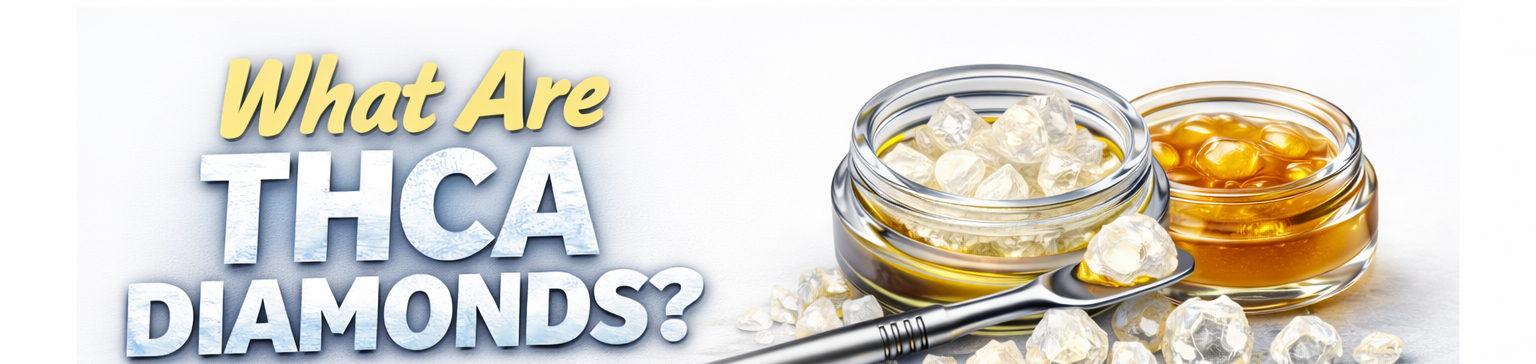
THCA diamonds are concentrated THCA that has separated and crystallized into solid, gem-like pieces. In cannabis education, “THC diamonds” is common shorthand, but the more chemically accurate name is THCA diamonds because the concentrate starts in the non-decarboxylated THCA form.
They can look clear, off-white, pale gold, or lightly amber depending on the extract and whether any sauce is present. On their own, purified diamonds tend to have very little flavor compared with terpene-rich concentrates, which is why many brands sell them with sauce instead of as dry crystals only.
THCA diamonds are best understood as a potency-first concentrate: the crystals deliver the punch, while any attached sauce usually supplies the flavor and aroma.
History and context
Diamonds became popular as extractors learned to control recrystallization inside cannabis extracts. As the concentrate market matured beyond wax and shatter, shoppers started seeing more products built around separated crystals, terp sauce, and “diamonds in sauce” style jars.
- Early concentrate era Formats like wax, shatter, and crumble introduced many shoppers to high-potency extracts before crystal-heavy products became mainstream.
- Diamond mining era Recrystallization techniques made it possible to intentionally form THCA crystals inside extracts, creating the “diamond” look and the diamonds-plus-sauce category.
- Current market Today, diamonds show up as isolated crystals, diamonds in sauce, live resin diamonds, and vape products marketed with “liquid diamonds” language.
How it works
Under controlled conditions, cannabinoids and terpenes can separate inside an extract. The THCA portion can organize into solid crystals, while the more liquid fraction stays rich in aromatic compounds often called sauce or terp sauce.
That separation explains why diamonds often test very high for THCA while still being sold together with an amber, terpene-rich liquid. Once heat is applied, THCA decarboxylates into THC, which is why diamond products are typically described as fast-acting and very strong.
What the evidence can and can’t say
The basic chemistry is well established: THCA can convert into THC with heat, and purified crystalline concentrates can reach very high cannabinoid purity. What is less settled is how much a terpene-rich “fuller” formula will feel different from a cleaner isolate-style product for every person.
For a reader-first takeaway, the strongest evidence here is chemistry and product form rather than medical promise. Research supports the THCA-to-THC conversion with heat, and cannabis reference sources consistently describe diamonds as a crystallized, high-purity concentrate often sold with sauce for added flavor.
- High purity is the defining trait — Reference sources describe diamonds and crystalline concentrates as unusually pure cannabinoid solids, often reaching the highest-potency end of the concentrate category.
- Heat changes the experience — THCA is the precursor form; when heated, it decarboxylates into THC, so label language matters if you are comparing raw numbers with likely in-use effects.
- Flavor usually lives outside the crystal — When diamonds are paired with sauce, the liquid fraction typically carries the aroma and much of the strain character, while the crystal portion mainly supplies potency.
Types and common forms
Not every diamond product is the same. The main differences come from how much sauce is present, whether the extract began as live resin, and whether the product is sold as a jarred concentrate or a vape-ready formula.
- Isolated THCA diamonds — Mostly crystal with little added sauce; often the most stripped-down and potency-first version.
- Diamonds in sauce — THCA crystals suspended in terpene-rich liquid, balancing intensity with more aroma and flavor.
- Live resin diamonds — Diamonds formed in a live-resin-style extract, usually marketed as a more strain-expressive option.
- “Liquid diamonds” vapes — A marketing label commonly used for vape oils built from highly refined THCA material plus terpenes; the exact formula can vary by brand.
How to use THCA diamonds in real life
In real life, THCA diamonds matter most when you are comparing concentrate labels. They help explain why one jar is sold as a clean, crystal-forward product while another leans into sauce, live resin character, or a vape-friendly blend.
- Decide whether you want a potency-first product or a flavor-first product before you compare prices.
- Read the product name closely: “diamonds,” “diamonds in sauce,” “live resin diamonds,” and “liquid diamonds” are related but not identical.
- Check whether the label lists terpene content or only cannabinoid potency, because that often hints at how stripped-down the formula is.
- Treat diamond products as a high-intensity category and compare them more like premium concentrates than casual entry-level formats.
Safety, legality, and what to watch for
Because THCA diamonds sit at the high-potency end of the category, label literacy matters. A shopper should understand whether the jar is mostly isolated crystals, crystals plus sauce, or a vape formula that uses diamond language more loosely.
Legality, age limits, testing rules, and product standards vary by state and by hemp-versus-marijuana framework. For any inhalable concentrate, third-party testing and clean processing are more important than flashy names or oversized crystals.
Quality checklist (COA / lab reports)
A useful COA for THCA diamonds should do more than show a big potency number. Because concentrates can concentrate contaminants too, it is smart to check both cannabinoid results and the core safety screens commonly required for regulated cannabis products.
- Match the product name to the chemistry: isolated diamonds, diamonds in sauce, live resin diamonds, and liquid diamonds should not all read like the same thing.
- Confirm cannabinoid potency and make sure the COA is recent, batch-specific, and easy to access.
- For solvent-made extracts, look for residual solvent results in addition to potency.
- Check contaminant panels such as pesticides, heavy metals, microbial impurities, and mycotoxins when available.
- Compare terpene information if flavor matters to you, because the sauce fraction usually carries that part of the experience.
- If the product is sold as “diamonds in sauce,” the COA should make sense for both potency and terpene content rather than reading like a pure isolate.
- Very large crystals can look impressive, but appearance alone does not prove cleaner extraction or better testing.
- Be cautious with vague terms like “liquid diamonds” when a seller does not explain the base oil and terpene source.
- Clear lab access, batch numbers, and processing transparency usually matter more than hype words.
How to shop smarter
The smartest way to shop THCA diamonds is to compare them by lane: pure crystal lane, diamonds-plus-sauce lane, live-resin lane, and vape lane. That keeps you from overpaying for a product that sounds premium but is really just using diamond language as marketing.
- If you want more aroma and nuance, prioritize diamonds with sauce or a live-resin-style formula over dry crystals alone.
- If you want a cleaner, more stripped-down profile, isolated diamonds are the more obvious fit.
- Use the COA and ingredient list to compare products, not just the front-label potency claim.
- Price should reflect both purity and transparency; expensive without testing is not premium.
Common myths (and what’s actually true)
THCA diamonds attract a lot of strong opinions, but a few common shortcuts lead shoppers in the wrong direction.
- “Diamonds are automatically the same as live resin.” — Not necessarily. Live resin diamonds are a specific subtype; isolated diamonds can be much more stripped-down than a terpene-rich live resin product.
- “Bigger crystals always mean a better product.” — Crystal size can be visually impressive, but lab testing, clean processing, and honest labeling matter more than looks.
- “THCA sounds mild because it is not THC yet.” — That framing misses the heat step: once heated, THCA converts to THC, which is why diamond products are treated as a very potent class.
FAQ
Are THCA diamonds the same thing as THC diamonds?
In everyday cannabis language, people often say “THC diamonds,” but THCA diamonds is the more accurate name because the crystal starts as tetrahydrocannabinolic acid. Heat changes that chemistry during use.
Do THCA diamonds have much flavor on their own?
Usually less than sauce-heavy concentrates. The more purified the crystal, the less aroma and flavor it tends to carry by itself, which is why many brands pair diamonds with terp sauce.
What is the simplest way to compare diamonds, sauce, and live resin?
A simple shortcut is this: diamonds point toward purity and potency, sauce points toward terpene-rich flavor, and live resin usually points toward stronger strain character from the starting extract.