Quick takeaway
CBD drinks can feel quicker and lighter for many people, while edibles usually build more slowly and last longer.
If you want faster feedback, start with a low‑mg drink. If you want longer coverage and easy mg counting, an edible is often the better fit.
Definition
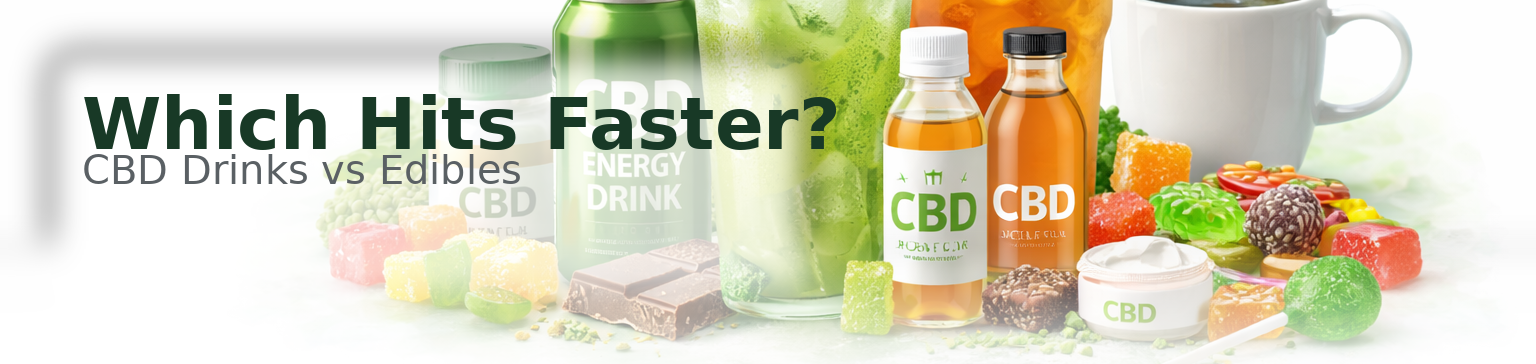
CBD drinks are ready‑to‑sip options like seltzers, teas, or shots. CBD edibles are gummies, chocolates, baked goods, or capsules that you swallow and digest.
Because digestion and formulation vary, the same number of milligrams can feel different between a drink and an edible—especially for first‑timers.
Drinks tend to fit “right now” moments; edibles fit “set it and ride it out” routines—choose based on timing and dose clarity.
History and context
CBD beverages took off as brands adopted water‑soluble emulsions for smoother mixing, while gummies and chocolates have remained the classic edible formats for years.
- Onset Drinks may be noticed sooner for some people (often ~15–45 min), while edibles more commonly take longer (45–120+ min).
- Peak Edibles often peak later and can feel stronger per mg; drinks may peak earlier and feel smoother.
- Duration Edibles commonly last longer (4–8+ hours) than drinks (2–6 hours), depending on dose and metabolism.
How it works
Both formats deliver CBD to your endocannabinoid system after absorption into the bloodstream.
Formulation matters: emulsified CBD in drinks may absorb a bit more efficiently, while fats and ingredients in edibles can change how CBD is processed.
What the evidence can and can’t say
Research is evolving and product quality varies widely. Start low, go slow, and rely on lab‑tested products for consistent dosing.
There isn’t a single “best” format backed by research. Most studies look at CBD itself, not whether it came from a beverage or a gummy—so practical experience and labeling matter a lot.
- Stress support — Some people use CBD for calm; drinks can be a “sip and assess” option for daytime routines.
- Sleep routines — Edibles are popular at night because they last longer—start low to avoid next‑day grogginess.
- Everyday comfort — Both formats can fit daytime comfort; consistency in dosing and quality matters most.
Types and common forms
You’ll see CBD in everything from seltzers to gummies. Here are common formats and where they fit best.
- CBD seltzers & sodas — Light, convenient servings—great for social settings and daytime calm.
- CBD teas & coffees — A familiar ritual; check mg per can and added caffeine or sugar.
- CBD gummies — Easy to dose (mg per piece) and portable; slower onset but longer lasting.
- CBD chocolates & baked edibles — Comfort‑food format that can feel stronger per serving; watch calories and dose size.
How to use CBD drinks and edibles in real life
When choosing between drinks and edibles, think about how quickly you want to feel it—and how long you want it to last.
- For faster feedback, start with a low‑mg drink and wait at least 60 minutes before adding more.
- For longer coverage, choose an edible with a clear mg‑per‑piece label and start low.
- Avoid stacking doses: drink + edible timing can overlap and feel stronger than expected.
- Take tiny notes (mg + time). It makes future picks much more predictable.
Safety, legality, and what to watch for
CBD can cause drowsiness and may interact with some medications. If you’re pregnant, nursing, or taking prescriptions, check with a clinician first.
Buy from brands that publish third‑party lab reports and avoid products with unclear hemp sources or vague cannabinoid labels.
Quality checklist (COA / lab reports)
The simplest way to avoid bad experiences is to choose products that publish a recent COA (certificate of analysis) from an independent lab.
- CBD amount matches the label (mg per serving)
- THC results are listed and within your comfort level
- Contaminant testing (pesticides, heavy metals, solvents)
- Batch number/date is current (ideally within the last year)
- Ingredients and serving size are clearly stated
- For drinks, look for emulsified or “water‑soluble” CBD for smoother mixing.
- For edibles, check mg per piece—not just total mg per bag.
- Be cautious with ultra‑high‑mg servings; more isn’t always better.
- Skip “mystery blends” that don’t list cannabinoids or testing.
How to shop smarter
Shop with your routine in mind—daytime, evening, or occasional use—and prioritize clear labeling.
- Start with low to moderate mg per serving (5–20 mg) when testing a new product.
- If you’re sensitive, choose single‑serve cans or smaller gummy counts so you can adjust.
- Check sugar/caffeine in drinks if you’re using CBD for sleep.
- Prefer brands that make lab reports easy to find (QR code or product page link).
Common myths (and what’s actually true)
CBD gets a lot of hype. These myths cause the most confusion when choosing a format.
- “CBD drinks work instantly.” — They can feel faster than edibles, but onset still varies—wait and assess before adding more.
- “More mg always means better.” — Higher doses can increase side effects; the best dose is the lowest that works for you.
- “All edibles feel the same.” — Ingredients, fats, and cannabinoid profiles can change timing and intensity.
FAQ
Do CBD drinks hit faster than edibles?
Often, yes—especially if the drink uses an emulsified or water‑soluble CBD blend. But timing still varies, so start low and wait.
Which lasts longer: CBD drinks or edibles?
Edibles usually last longer because digestion is slower. Many people report longer “coverage” from gummies than from drinks at the same mg.
Can I take a CBD drink and an edible together?
You can, but it’s easy to overdo it because their timing overlaps. If you combine, keep doses small and spaced out.