
Full Spectrum vs Broad Spectrum vs Isolate
Full spectrum, broad spectrum, and isolate describe intended cannabinoid profiles—not guaranteed quality levels. This guide explains what the labels usually mean, what they cannot prove, and how shoppers can compare a product with its batch-specific certificate of analysis.
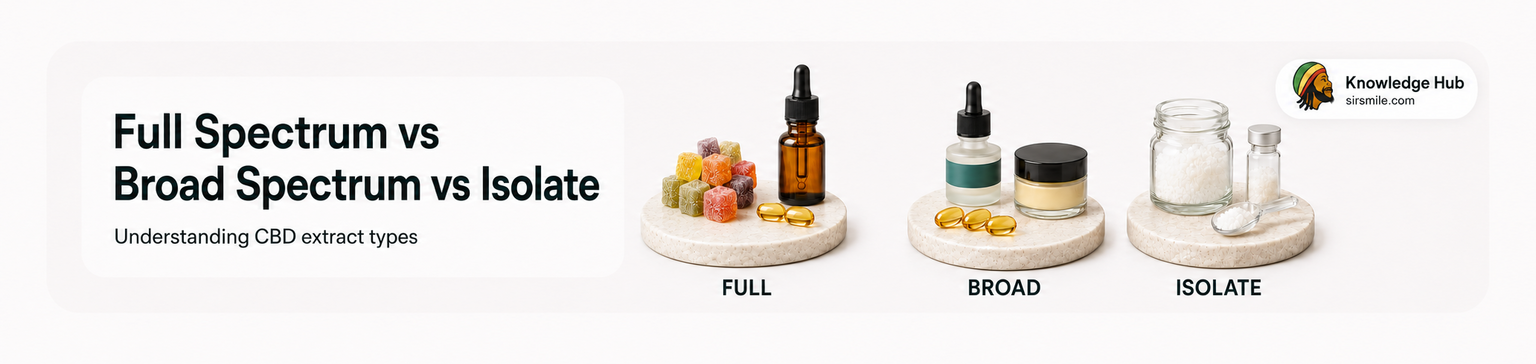
Intended to contain highly purified CBD with little or no measurable amount of other cannabinoids.
Usually marketed as a multi-component extract with THC removed or below the laboratory reporting limit.
Usually marketed as a broader extract that may include THC and other measured cannabinoids.
A complete, recent COA that matches the product and lot and reports cannabinoids with detection limits.
What full spectrum, broad spectrum, and isolate usually mean
Industry terminology The three labels describe an intended ingredient profile. They do not identify a delivery format. An oil, gummy, capsule, topical, beverage, or other product can be made with isolate, a broad-spectrum ingredient, or a full-spectrum extract.
CBD isolate
CBD isolate is intended to be cannabidiol separated from most other extract components. In raw ingredient form it may appear as a white crystalline powder, but a finished isolate gummy or oil will usually look like any other finished product. “Isolate” should not be interpreted as automatically pharmaceutical-grade, contaminant-free, or zero-risk.
Broad-spectrum CBD
Broad spectrum generally means that CBD remains with some additional cannabinoids or extract constituents while THC has been intentionally removed or reduced below a chosen reporting threshold. Manufacturers do not all use the same cannabinoid recipe, processing endpoint, or laboratory limit. Two broad-spectrum products can therefore have very different measured profiles.
Full-spectrum CBD
Full spectrum generally refers to an extract intended to retain a wider mixture of compounds from its source material. It may include measurable THC along with CBD and other cannabinoids. The word full does not mean every naturally occurring compound is present, nor does it establish how much of each compound remains.[1]
Full spectrum vs broad spectrum vs isolate at a glance
| Question | Full spectrum | Broad spectrum | Isolate |
|---|---|---|---|
| Intended profile | CBD plus a broader range of extract components. | CBD plus selected additional components, with THC removed or minimized. | Highly purified CBD with few or no other measurable cannabinoids. |
| Can THC be present? | Yes, depending on the formulation and current legal limits. | It should be checked rather than assumed absent; “not detected” depends on the method limit. | Pure CBD itself contains no THC, but a finished product still depends on manufacturing and testing. |
| Are other cannabinoids guaranteed? | No fixed list or amount is guaranteed by the word alone. | No. The retained profile varies by manufacturer. | They are generally not intended to remain in meaningful amounts. |
| Does the category predict effectiveness? | No. | No. | No. |
| Does it guarantee a drug-test outcome? | No; measured THC may increase risk. | No; verify the THC panel and understand that zero risk cannot be promised. | No finished retail product can promise a universal outcome, although verified pure CBD is not the target of standard THC testing. |
| Best verification | Exact product and lot match, complete cannabinoid panel, units, detection limits, ingredients, and relevant contaminant results. | ||
None of the columns is a ranking. A well-documented isolate product can be more trustworthy than a poorly documented full-spectrum product, and the reverse can also be true. Spectrum and quality answer different questions.
Why spectrum labels are not complete standards
Established fact Researchers can chemically distinguish a botanical extract from purified CBD, but retail spectrum language is not a single, universally enforced formulation standard. Manufacturers may choose different starting materials, refinement methods, target compounds, detection limits, and labeling rules.[1]
A 2024 analysis of 202 commercially available CBD tinctures, gummies, vapes, and topicals found that 74% differed from their CBD label claim by at least 10%, and 26% did not match the spectrum-type claim on the package. The researchers also reported contaminants across products. The study disclosed industry funding, which is part of the context readers should consider alongside its methods and results.[2]
How manufacturers create different cannabinoid profiles
Industry terminology At a high level, manufacturers obtain an extract and then refine, separate, concentrate, or recombine components to reach a target profile. A full-spectrum ingredient may receive less compositional narrowing. A broad-spectrum ingredient generally receives additional processing intended to reduce THC while retaining selected components. Isolate production goes further toward separating and purifying CBD.
The process description does not prove the finished result. Compounds can be lost, remain unexpectedly, degrade, or be introduced through formulation. Some finished products are assembled by combining separately produced ingredients rather than by carrying one unchanged extract from start to finish.
Shopper-verifiable The finished-product COA matters more than an attractive diagram of the extraction process. A raw-material report does not necessarily describe the gummy, oil, or cream ultimately sold.
What color, taste, and packaging can—and cannot—prove
Full-spectrum products are sometimes darker or more strongly flavored, while isolate ingredients are often pale and neutral. Those tendencies are not reliable identification tests. Carrier oils, flavors, colors, sweeteners, emulsifiers, oxidation, concentration, and packaging can change a product’s appearance and taste.
- A clear oil is not proof of CBD isolate.
- A dark or earthy oil is not proof of full spectrum.
- A white powder is not proof of identity, purity, or safety.
- A “THC-free” badge is not a laboratory result.
- A high price, dark bottle, organic-style design, or plant imagery is not proof of quality.
How to verify a spectrum claim on a COA
Shopper-verifiable A certificate of analysis describes a tested sample. Its value depends on whether that sample can be connected to the finished product in hand. FDA has specifically identified online COAs as an area where quality communication can be compared with actual product ingredients.[3]
| Check | What to verify | Why it matters |
|---|---|---|
| Product and lot | Name, format, strength, batch or lot, and sample description match the package. | A report for another batch or raw ingredient does not verify this finished product. |
| Laboratory and dates | Lab identity, report date, received date, and completed date are present. | Shows who tested the sample and when. |
| CBD amount | Measured CBD can be translated into the package’s milligrams per serving and total amount. | Confirms whether the potency math is plausible. |
| Other cannabinoids | The panel identifies which cannabinoids were tested and their measured amounts. | Supports—or challenges—the intended spectrum profile. |
| THC compounds | Relevant THC results, units, and reporting limits are shown. | “ND” only means not detected above a stated method threshold. |
| Complete pages | Methods, limits, signatures or authentication, and all result pages are available. | A cropped screenshot or green “pass” badge removes essential context. |
| Contaminants | Relevant heavy-metal, pesticide, solvent, microbial, and mycotoxin panels are included where appropriate. | A cannabinoid-only report cannot prove contaminant screening. |
For an isolate claim, the report should show CBD and no unexpected cannabinoid pattern above the reported limits. For a broad-spectrum claim, the report should show what additional cannabinoids remain and how THC was reported. For a full-spectrum claim, the measured cannabinoid profile—including THC—should be reviewed rather than inferred from the word full.
THC exposure and drug testing
Pure CBD is not the target of standard THC drug tests, but retail products can contain THC because it is intentionally present, remains after processing, appears through contamination, or is inaccurately labeled.
In one open-label study of 15 participants using a full-spectrum hemp-derived product for four weeks, 7 participants tested positive for the THC metabolite THC-COOH after the study period.[5] Controlled research has also shown that pure CBD itself does not create the same THC-positive urine result, while CBD-dominant products containing THC can create risk.[6]
No spectrum label can guarantee a testing outcome
A batch report can reduce uncertainty, but it cannot promise how every laboratory, cutoff, pattern of use, metabolism, or future batch will behave. Someone facing employment, probation, athletic, military, medical, or other consequential testing should treat “THC-free” marketing cautiously.
Choosing based on constraints—not hype
This guide does not select a universally “best” spectrum. A more useful decision begins with what must be verified.
| Priority | What to examine |
|---|---|
| Minimizing THC exposure | Measured THC results, reporting limits, batch match, cross-contamination controls, and the consequences of any exposure. Broad spectrum and isolate labels alone are not guarantees. |
| Simpler cannabinoid profile | An isolate claim supported by a complete cannabinoid panel and a short, understandable ingredient list. |
| Broader measured profile | The exact cannabinoids present and their amounts—not merely “whole plant” wording. |
| Medication or health concerns | Discuss CBD itself, other active ingredients, route, amount, and frequency with a qualified clinician or pharmacist. Spectrum does not remove CBD interaction risks. |
| Product quality | Finished-product potency, contaminant scope, lot traceability, manufacturer identity, and realistic claims. |
A practical spectrum-shopping checklist
- Read the complete product name. Confirm whether the label says full spectrum, broad spectrum, isolate, or only the vague phrase “hemp extract.”
- Match the finished product and lot. Do not rely on a generic COA folder or a report for bulk oil.
- Check the cannabinoid panel. Look beyond CBD to the other reported cannabinoids and relevant THC compounds.
- Read the units and limits. Distinguish milligrams per gram, milligrams per milliliter, percent, per-serving amounts, and “not detected” thresholds.
- Do the serving math. Compare measured CBD with the package’s serving size, servings per container, and total labeled CBD.
- Review contaminant testing. Potency alone does not cover metals, pesticides, solvents, microbes, or mycotoxins.
- Read every ingredient. Carrier oils, flavors, allergens, caffeine, melatonin, botanicals, or other cannabinoids may matter more than the spectrum word.
- Reject treatment promises. A spectrum category does not prove that a retail product treats pain, anxiety, insomnia, inflammation, cancer, or another condition.
- Check the business and current rules. Look for contact information, policies, shipping restrictions, adverse-event reporting, and requirements where the buyer lives.
Safety and legal context
CBD risks do not disappear when THC is removed
FDA identifies liver injury, drug interactions, drowsiness, gastrointestinal effects, appetite changes, and mood changes among CBD concerns. Alcohol and other drugs that slow brain activity can add to sedation.[3]
In a 2025 FDA randomized trial, healthy adults received 250–550 mg of CBD daily for 28 days. Eight participants receiving CBD—5.6% of those at risk at week four—had ALT or AST elevations above three times the upper limit of normal, while none in the placebo group did. The studied amounts may be higher than many single retail servings, but the finding reinforces that purified CBD itself can have biological risks.[4]
- Consult a qualified clinician or pharmacist when medicines, liver concerns, pregnancy, breastfeeding, or other health questions apply.
- Do not drive or operate machinery if drowsy, slowed, dizzy, or otherwise impaired.
- FDA strongly advises against CBD, THC, and marijuana use during pregnancy or breastfeeding.[7]
- Keep gummies and other products secured away from children and pets.
Legal status is more complicated than “hemp-derived”
FDA states that CBD cannot currently be marketed as a dietary supplement and that foods with added CBD cannot be introduced legally into interstate commerce under the agency’s interpretation. State rules may differ.[3][8]
Federal hemp law is also in transition. Public Law 119-37, enacted November 12, 2025, schedules changes to the federal hemp definition 365 days after enactment, including new treatment of total tetrahydrocannabinols and finished hemp-derived cannabinoid products. Implementation, later amendments, agency guidance, state rules, and the product’s destination must all be checked at the time of a transaction.[9]
Common spectrum myths—and better answers
| Myth | Better answer |
|---|---|
| “Full spectrum is always strongest.” | Spectrum describes intended composition, not a universal potency or effectiveness ranking. |
| “Broad spectrum means absolutely zero THC.” | Check the batch result and reporting limit. “Not detected” is method-dependent. |
| “Isolate products are automatically pure.” | An isolate ingredient can still be inaccurately formulated, contaminated, degraded, or placed in a complex finished product. |
| “Full spectrum always causes a high.” | The experience depends on actual THC and other ingredients, amount, route, individual sensitivity, and product accuracy. Do not infer composition from the label alone. |
| “The entourage effect proves full spectrum is better.” | The hypothesis does not establish that every mixture outperforms CBD isolate for every purpose. |
| “A QR code proves quality.” | Only a complete, relevant, batch-matched report with understandable results provides meaningful evidence. |
Frequently asked questions
Is full spectrum better than broad spectrum?
Not universally. The categories describe different intended profiles. Quality and suitability depend on the actual formulation, batch results, ingredients, safety context, and the shopper’s constraints.
Does broad spectrum contain THC?
Broad-spectrum products are generally intended to remove or minimize THC, but the label is not a guarantee. Review which THC compounds were tested and the laboratory’s detection or quantitation limits.
Is CBD isolate completely THC-free?
CBD as an isolated molecule is not THC. A retail product labeled isolate still requires finished-product testing because manufacturing errors, contamination, and inaccurate labeling can occur.
Can full-spectrum CBD cause a positive drug test?
Yes, it can increase risk because full-spectrum products may contain THC. A small four-week study documented positive THC-metabolite results in some participants using a full-spectrum hemp-derived product.[5]
What does “ND” mean on a COA?
It usually means the laboratory did not detect the analyte above the method’s stated reporting limit. It does not mean the laboratory proved an absolute zero.
Can gummies and topicals use any spectrum type?
Yes. Spectrum describes the cannabinoid ingredient profile, while gummy, oil, capsule, drink, and topical describe the finished format.
Can color reveal whether CBD is full spectrum?
No. Formulation and processing can change color and taste. Verify the label with a complete cannabinoid panel.
Does removing THC remove CBD safety concerns?
No. CBD itself can cause side effects and drug interactions and has been associated with liver-enzyme elevations. Spectrum type does not replace medical or medication review.
Bottom line
Full spectrum, broad spectrum, and isolate are useful shorthand, but they are not self-proving standards. Full spectrum generally points toward a broader extract that may include THC. Broad spectrum generally points toward a multi-component profile with THC removed or minimized. Isolate points toward highly purified CBD.
The most trustworthy comparison connects the category label to the exact product, lot number, complete ingredient list, cannabinoid panel, reporting limits, contaminant scope, seller identity, safety context, and current law. The shorter the slogan, the more important the supporting evidence becomes.
How this guide was researched
Research method: Anthony Cameron reviewed FDA and NIH/NCCIH consumer and regulatory materials, the 2025 FDA randomized CBD safety trial, federal statutory text, peer-reviewed work distinguishing botanical extracts from CBD isolate, commercial-product label-accuracy research, and human drug-testing studies. Spectrum vocabulary was treated as industry terminology unless a specific chemical result supported it.
Human review: AI-assisted research and drafting tools helped organize source material; Anthony selected the sources, checked the claims, and approved the final wording. Unsupported superiority, treatment, dosing, and zero-risk claims were removed. Shopper guidance was limited to information readers can verify on labels, complete COAs, business policies, and current official rules.
Sources and further reading
- Peer reviewed Marinotti and Sarill, “Differentiating Full-Spectrum Hemp Extracts from CBD Isolates”, a phytochemical and toxicological discussion of botanical extracts and purified CBD.
- Peer reviewed Gidal and colleagues, product labeling accuracy and contamination analysis of 202 commercially available CBD products. The publication reports spectrum-label and potency discrepancies and discloses industry funding.
- Official U.S. Food and Drug Administration, What to Know About Products Containing Cannabis or CBD, and FDA’s Cannabis-Derived Products Data Acceleration Plan.
- FDA randomized trial U.S. Food and Drug Administration, CDER Investigators Address the Safety of CBD in a Randomized Trial.
- Peer reviewed Dahlgren and colleagues, urinary THC after four weeks of a full-spectrum hemp-derived product.
- Controlled research Sholler and colleagues, urinary cannabinoid profiles after CBD, CBD-dominant cannabis, and THC-dominant cannabis. See also Spindle and colleagues’ controlled study of acute pure CBD dosing and urine testing.
- Official U.S. Food and Drug Administration, CBD, cannabis, pregnancy, and breastfeeding.
- Official National Center for Complementary and Integrative Health, Cannabis, Marijuana, and Cannabinoids: What You Need To Know.
- Federal statute Public Law 119-37, section 781, enacted November 12, 2025, with hemp-definition amendments scheduled 365 days after enactment.
Keep learning on Sirsmile
Continue with What is CBD?, How to Read a CBD Lab Report (COA), CBD Drinks vs Edibles, or return to the Sirsmile Knowledge Hub.