
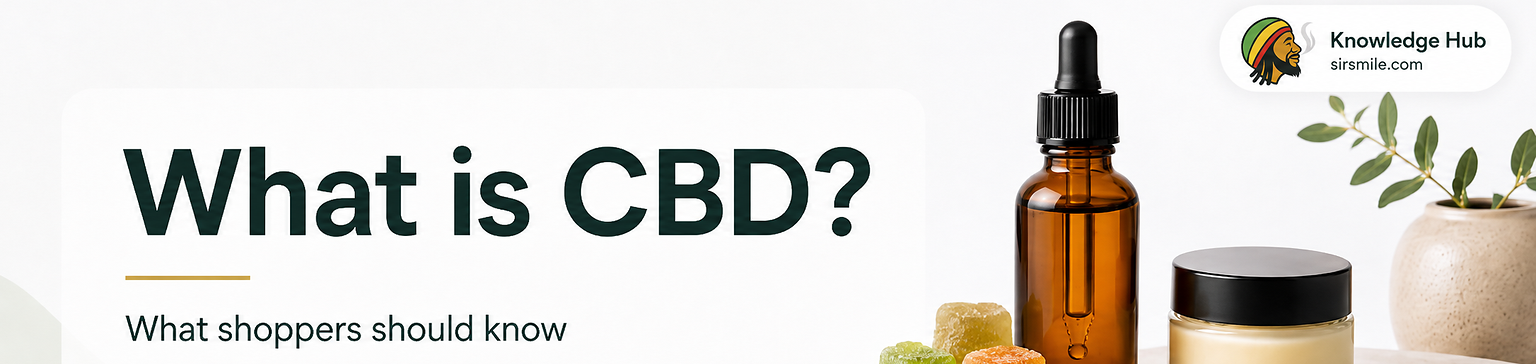
What is CBD?
CBD is everywhere—from oils and gummies to creams and prescription medicine—but the same three letters can sit on products with very different ingredients, evidence, and risks. This guide explains what CBD is, what research can honestly support, and how to read a product beyond the front label.
Cannabidiol, a cannabinoid that may be plant-derived or manufactured as a purified ingredient.
The same compound as THC, a guarantee of zero THC, or proof that a product treats a condition.
Prescription cannabidiol is approved for seizures linked to three specific disorders in patients age 1 and older.
Exact serving amount, complete ingredients, batch-matched COA, THC results, contaminant testing, and current local rules.
What CBD actually is
Established fact CBD is the common abbreviation for cannabidiol. It is one of many cannabinoids associated with Cannabis sativa. The plant primarily makes acidic precursor compounds—including CBDA—which can be converted into CBD through processing and heat. CBD can then appear as part of a plant extract or as a highly purified ingredient.
That definition is simple. The marketplace is not. “CBD” may appear on a prescription oral solution, a hemp extract, a gummy, a cosmetic, a vape liquid, or a bottle that says only “hemp oil.” Those products can differ in dose, route of use, other cannabinoids, contaminants, manufacturing controls, and legal status.
CBD oil is not automatically hemp seed oil
Established fact Hemp seeds do not naturally contain meaningful CBD or THC. Hemp seed oil is primarily a food or carrier oil made from seeds; CBD oil is usually formulated with cannabidiol or a cannabinoid-containing extract from other plant material. The vague phrase hemp oil can be used inconsistently, so the ingredient list and stated milligrams matter more than the front label.[3]
CBD and THC are related—but not interchangeable
CBD and delta-9 THC can come from the same plant, yet they do not produce the same typical experience. THC is the principal intoxicating cannabinoid in cannabis. CBD itself is not intoxicating like THC.[1]
| Question | CBD | Delta-9 THC |
|---|---|---|
| Does the compound typically cause a cannabis “high” by itself? | No. CBD is not intoxicating like THC. | Yes. THC is the principal intoxicating cannabinoid. |
| Can a CBD-labeled product still expose someone to THC? | Yes. Full-spectrum products may contain THC, and inaccurate labeling or contamination can occur. | THC exposure depends on the actual product amount and composition. |
| Does CBD reliably cancel THC? | No. The interaction depends on dose, route, timing, and formulation. | Oral THC effects may be stronger when a large oral CBD dose slows THC metabolism. |
| Is the front label enough to know the contents? | No. Check the batch-matched laboratory report. | No. Check the measured cannabinoid panel and units. |
A particularly useful correction to popular lore is that CBD does not automatically “balance out” THC. In a randomized oral study, a CBD-dominant extract containing the same THC dose produced greater THC exposure and stronger effects than THC alone. That result does not predict every product or route, but it shows why slogans are weaker than actual formulation data.[10]
How CBD works: there is no single switch
The endocannabinoid system is often described as though every cannabinoid simply plugs into the same receptor. That is too neat. THC strongly engages cannabinoid receptors linked to intoxication. CBD has much lower affinity for the primary CB1 and CB2 receptor sites and appears to influence several biological pathways indirectly. Its mechanisms can vary by concentration, tissue, and experimental model.
This matters because broad statements such as “CBD activates the endocannabinoid system” can sound more certain than the science allows. A biological mechanism observed in a laboratory does not automatically prove that a retail product treats pain, anxiety, inflammation, or sleep problems in people.
Established fact Route and formulation also matter. Swallowed CBD is affected by digestion, liver metabolism, and food. The FDA-approved oral solution instructs patients to take it consistently in relation to meals because food can change CBD exposure.[4] This is one reason two products with the same front-label milligrams may not behave identically.
What the evidence supports—and where it remains incomplete
The most important distinction is between a specific product studied for a specific use and the much broader marketplace of CBD products. Evidence does not transfer automatically from prescription cannabidiol to an unapproved gummy, cream, beverage, or vape.
| Topic | What can be said responsibly | What should not be assumed |
|---|---|---|
| Certain rare seizure disorders | FDA-approved purified cannabidiol has demonstrated benefit for seizures associated with Lennox-Gastaut syndrome, Dravet syndrome, and tuberous sclerosis complex in patients age 1 and older.[2][4] | That every retail CBD product is equivalent, approved, correctly dosed, or appropriate for epilepsy. |
| Anxiety | Small clinical studies and systematic reviews report some promising findings, but doses, diagnoses, formulations, and study designs vary widely. Recent reviews describe contradictory results and call for better trials.[11] | That CBD is a proven replacement for established anxiety treatment or that one retail dose works for everyone. |
| Sleep | Evidence remains mixed. In a small 2024 insomnia trial, 150 mg nightly CBD was similar to placebo for most sleep outcomes, despite some differences in well-being and sleep efficiency.[12] | That drowsiness equals healthier sleep or that a low-dose gummy has been proven to treat insomnia. |
| Chronic pain | Research on cannabis-based products often involves THC, THC/CBD combinations, or specific medical formulations. NCCIH describes evidence for cannabis and cannabinoids as condition- and product-specific.[5] | That evidence for THC-containing cannabis proves CBD alone is an effective pain treatment. |
| General “wellness” | Some shoppers use CBD as part of a personal routine, but “wellness” is not a precise clinical outcome. | That popularity, testimonials, or a calming package design establish effectiveness. |
The fairest conclusion is neither “CBD cures everything” nor “CBD does nothing.” CBD is an active compound with one established prescription role, genuine safety considerations, and many other uses still being researched. Good education protects that nuance.
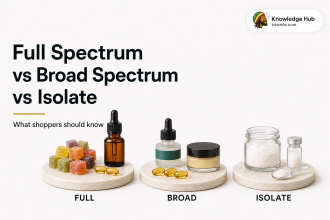
Isolate, broad spectrum, and full spectrum: useful labels, imperfect guarantees
Industry terminology These terms usually describe how much of the original cannabinoid mixture a manufacturer intends to retain:
- CBD isolate: intended to contain highly purified CBD with little or no other cannabinoids.
- Broad-spectrum CBD: generally marketed as CBD plus other plant compounds, with THC removed or kept below the product’s reporting limit.
- Full-spectrum CBD: generally marketed as a broader mixture of cannabinoids and other extract components, potentially including THC within applicable limits.
There is no reason to treat one category as automatically superior. Isolate may appeal to someone seeking a simpler cannabinoid profile. A full-spectrum product may appeal to someone who intentionally wants a broader extract. Neither label proves effectiveness, purity, or accurate potency.
A 2024 analysis of 202 commercially available CBD tinctures, gummies, vapes, and topicals found that 74% differed from their CBD label claim by at least 10%. Twenty-six percent did not match the spectrum-type claim on the package. Earlier peer-reviewed testing also found label-accuracy problems across online CBD extracts and hemp-derived topical products. The study also detected heavy metals, residual solvents, and pesticides across multiple products, although only a smaller share exceeded the regulatory thresholds used by the researchers.[8][9]
CBD formats are not just different packaging
Industry terminology Product format changes how CBD is used and what information matters. Milligrams should not be compared without context.
| Format | What the number may describe | Questions worth asking |
|---|---|---|
| Oil or “tincture” | Total CBD in the bottle, CBD per milliliter, or CBD per labeled dropper. | Is the dropper volume stated? Does the serving math match the bottle total? Is it meant to be swallowed or held in the mouth? |
| Gummy or capsule | CBD per piece and total CBD per package. | How many pieces equal a serving? Are THC and other cannabinoids listed per piece or only per package? |
| Topical | Often total CBD in the entire jar or tube. | What is the container size? Is it an ordinary topical or a specifically designed transdermal product? What other active ingredients are present? |
| Vape product | CBD concentration, total milligrams, or a percentage. | What are the carrier ingredients, hardware details, cannabinoid results, and contaminant tests? Inhaled products add respiratory and device-quality considerations. |
| Beverage or mix | CBD per container or per serving. | Does the container contain more than one serving? Is the amount clearly separated from other ingredients? |
A “1,000 mg CBD” bottle can sound stronger than a “25 mg CBD” gummy, but the first number may describe an entire bottle while the second describes one piece. Always reduce the comparison to CBD per stated serving, number of servings, and actual product type.
How to read a CBD certificate of analysis without being impressed by the QR code
Shopper-verifiable A certificate of analysis, or COA, is a laboratory report for a tested sample. It can be useful, but only when the report can be connected to the product in your hand.
| Check | What to verify | Why it matters |
|---|---|---|
| Batch or lot match | The package number matches the report exactly. | A beautiful report from another batch does not verify the current product. |
| Product identity | Brand, product name, format, flavor or strength, and sample description are recognizable. | Prevents a raw extract or different strength from being presented as the finished product. |
| Laboratory and dates | Lab name, contact information, report date, sample-received date, and test-completed date are present. | Shows who tested the sample and whether the report is current enough to be relevant. |
| CBD amount and units | Results can be translated into milligrams per piece, milliliter, gram, or package. | Percentages and mg/g values may not match the front-label serving without calculation. |
| THC panel | Delta-9 THC and other relevant THC compounds are reported with detection limits. | “ND” means not detected above a method limit; it does not mean metaphysical zero. |
| Contaminant scope | Heavy metals, pesticides, residual solvents, microbes, and mycotoxins are included when relevant to the product and jurisdiction. | A potency-only COA cannot establish contaminant testing. |
| Actual results | The report shows numbers, reporting limits, methods, and pass/fail criteria—not only a green “passed” badge. | Testing requirements and thresholds vary, so the context matters. |
A practical CBD shopping checklist
- Identify the actual product. Look for CBD isolate, broad spectrum, full spectrum, or another clearly described extract—not only “hemp oil.”
- Find the serving math. Confirm CBD per serving, serving size, total servings, and total CBD in the package.
- Read the complete ingredient list. Check carrier oils, sweeteners, allergens, added botanicals, melatonin, caffeine, or other active ingredients.
- Decide whether THC matters to you. Employment testing, driving, medication, sensitivity, travel, and local rules can make even small THC exposure important.
- Open the COA before purchasing. Match the product and batch, then review cannabinoid and contaminant panels.
- Look for realistic language. “Supports,” “may,” and transparent uncertainty are more credible than claims to cure pain, anxiety, cancer, inflammation, or insomnia.
- Check the seller behind the package. Look for a real business identity, contact method, return policy, shipping restrictions, and a way to report problems.
- Protect children and pets. Gummies and flavored products can resemble ordinary food. Use child-resistant storage and keep them out of sight and reach.
Price alone is weak evidence. So are dark glass, earthy colors, “organic-style” graphics, oversized milligram numbers, and the words premium or doctor-formulated. The strongest clues are specific, connected, and verifiable.
Safety and legal context
CBD is active—and “non-intoxicating” does not mean risk-free
FDA identifies potential liver injury, drug interactions, drowsiness, diarrhea, decreased appetite, and mood changes among CBD concerns. Alcohol and other drugs that slow brain activity can add to sedation.[6] Controlled human research also shows that CBD can inhibit several drug-metabolizing enzymes, which is why a medication review matters more than a generic online interaction list.[14] The prescription CBD label includes liver monitoring, sedation warnings, and multiple drug-interaction pathways.[4]
A 2025 FDA randomized trial gave healthy adults 250–550 mg of CBD per day for 28 days. ALT liver-enzyme elevations above three times the upper limit of normal occurred in 5.6% of participants receiving CBD and in none of the placebo participants, reinforcing that liver effects are not limited to patients taking the highest prescription doses.[7] That dose range is higher than many single retail servings, but some consumers combine products or use CBD daily.
- Talk with a qualified clinician or pharmacist before using CBD with prescription medicines, especially drugs requiring close blood-level control.
- Do not drive or operate machinery if you feel sleepy, slowed, dizzy, or otherwise impaired.
- FDA strongly advises against CBD use during pregnancy or breastfeeding.[13]
- Do not give adult CBD products to children or pets. Prescription cannabidiol use is a separate medical decision.
- Seek medical help for severe reactions, persistent vomiting or diarrhea, unusual fatigue, jaundice, or other concerning symptoms.
CBD legality is not one yes-or-no question
“Hemp-derived” does not settle every legal issue. Federal controlled-substance definitions, FDA rules for foods, supplements, and drugs, state cannabinoid laws, age restrictions, product-potency rules, and shipping rules can overlap—and they change.
FDA states that CBD cannot currently be sold legally as a dietary supplement and that foods with added CBD cannot be introduced legally into interstate commerce under the agency’s current interpretation. State rules for in-state products may differ.[5][2] A product being easy to buy online is not the same as every aspect of its sale, labeling, ingredients, or destination being lawful.
Common CBD myths—and better answers
| Myth | Better answer |
|---|---|
| “CBD cannot make you feel anything.” | CBD is not intoxicating like THC, but it can cause drowsiness, gastrointestinal effects, mood changes, and drug interactions. |
| “CBD always cancels THC.” | No. In at least one controlled oral study, a large CBD dose increased THC exposure and effects.[10] |
| “Full spectrum is always better.” | It is a formulation preference, not a universal quality ranking. It may also increase the importance of THC verification. |
| “Lab tested means safe.” | Ask what was tested, for which batch, by which lab, using what limits, and whether the full report is available. |
| “Hemp-derived means legal everywhere.” | No. Product composition, category, destination, and current federal and state rules all matter. |
| “More milligrams must work better.” | Higher exposure may also increase side effects and interactions. There is no universal retail CBD dose proven for every goal. |
| “FDA-approved CBD means CBD products are FDA approved.” | FDA approval applies to one specific prescription medicine for specific seizure disorders—not to the general retail market. |
Frequently asked questions
Does CBD get you high?
Purified CBD is not intoxicating like delta-9 THC. A CBD-labeled product may still contain THC or other intoxicating cannabinoids, so the product’s measured composition matters more than the category name.
Is CBD addictive?
CBD itself has shown low abuse potential in human and international reviews, but that does not make every CBD-labeled product identical or risk-free. Products containing THC or other active cannabinoids have a different profile.[1]
Can CBD cause a positive drug test?
Pure CBD is not the target of standard THC drug testing, but full-spectrum products, mislabeled products, or contamination can expose a user to THC. Anyone for whom a positive test would have serious consequences should not treat “THC-free” wording as a guarantee.
How much CBD should someone take?
There is no universal consumer dose that can be recommended safely for every product, goal, body, or medication list. FDA has not established a generally safe daily intake for ordinary retail CBD products.[6] A clinician or pharmacist can help assess interactions and personal risk; this guide does not provide dosing instructions.
Is CBD oil the same as hemp seed oil?
No. CBD oil is formulated to contain cannabidiol. Hemp seed oil is pressed from seeds, which do not naturally contain meaningful CBD or THC. Because “hemp oil” can be ambiguous, check the ingredient list and stated CBD amount.[3]
What does “THC-free” mean on a COA?
Often it means THC was not detected above the laboratory method’s reporting limit. Check which THC compounds were tested and the stated limit of detection or quantitation.
Are CBD gummies, oils, and creams equivalent?
No. They use different routes, serving calculations, ingredients, and product assumptions. A topical jar’s total milligrams cannot be compared directly with milligrams per swallowed gummy.
Is prescription CBD the same as store-bought CBD?
No. The approved prescription product has a standardized formulation, labeled indications, controlled manufacturing, clinical evidence, professional dosing, and safety monitoring. A retail product should not be substituted for it.
Bottom line
CBD is a real, pharmacologically active compound—not a miracle, not a placebo by definition, and not a blank check for every claim placed beside it. One prescription CBD medicine has strong evidence for specific seizure disorders. Other potential uses range from promising but incomplete to poorly supported, depending on the question and product.
The best shopper does not stop at “CBD,” “full spectrum,” or “lab tested.” They connect the serving math, ingredients, THC claim, batch number, complete COA, seller identity, safety context, and current rules. That process is less exciting than a testimonial—but far more useful.
How this guide was researched
Research method: Anthony Cameron reviewed FDA, NIH/NCCIH, NIDA, and WHO materials; current federal regulatory information; the FDA-approved cannabidiol label; randomized human trials; systematic reviews; and peer-reviewed product-label and contaminant studies. Official and peer-reviewed sources were used for medical, safety, pharmacology, and legal statements. Retail spectrum terminology was treated as industry vocabulary rather than a uniform scientific standard.
Human review: AI-assisted research and drafting tools helped organize source material; Anthony selected the sources, checked the claims, and approved the final wording. Unsupported treatment promises were removed, conflicting evidence was described as uncertain, and shopper guidance was limited to details readers can verify themselves.
Sources and further reading
- Official National Institute on Drug Abuse, Cannabis (Marijuana), including the distinction between intoxicating THC and non-intoxicating CBD. See also the World Health Organization’s Cannabidiol Critical Review Report.
- Official U.S. Food and Drug Administration, FDA Regulation of Cannabis and Cannabis-Derived Products, Including CBD.
- Official U.S. Food and Drug Administration, FDA response on hemp seed-derived food ingredients. Explains that hemp seeds do not naturally contain CBD or THC.
- Official drug label U.S. Food and Drug Administration, Epidiolex (cannabidiol) prescribing information.
- Official National Center for Complementary and Integrative Health, Cannabis, Marijuana, and Cannabinoids: What You Need To Know.
- Official U.S. Food and Drug Administration, What to Know About Products Containing Cannabis or CBD.
- FDA randomized trial Florian and colleagues, “Cannabidiol and Liver Enzyme Level Elevations in Healthy Adults”, with the FDA’s plain-language study summary.
- Peer reviewed Gidal and colleagues, product labeling accuracy and contamination analysis of 202 commercially available CBD products. The study disclosed industry funding; its methods and findings should be read with that context.
- Peer reviewed Spindle and colleagues, cannabinoid content and label accuracy of hemp-derived topical products.
- Randomized clinical trial Zamarripa and colleagues, assessment of orally administered THC with and without CBD. See also the NCCIH research summary.
- Systematic review Coelho and colleagues, review of randomized trials of CBD for anxiety disorders.
- Randomized trial Narayan and colleagues, 150 mg nightly CBD for moderate-to-severe insomnia.
- Official U.S. Food and Drug Administration, CBD, cannabis, pregnancy, and breastfeeding.
- Peer reviewed Bansal and colleagues, evaluation of cannabinoid interactions with cytochrome P450 drug metabolism in healthy adults.
Keep learning on Sirsmile
Continue with CBD Drinks vs Edibles, Full Spectrum vs Broad Spectrum, What Is THCA?, What Is Delta-8?, or return to the Sirsmile Knowledge Hub.